

What Is a Robotic Dolly? Pros, Uses & Limitations
In today’s fast-paced commercial video production and broadcast workflow, camera movement has become an increasingly dynamic tool for storytelling. If you’re a production team, director of photography (DP), or camera operator, you’ve likely encountered the challenge of creating smooth, repeatable, dramatic camera moves without sacrificing time or safety. Enter the robotic dolly — a powerful camera motion device that takes the well-worn dolly concept and brings automation, precision and versatility to the set.
Key Takeaways
Whether you’re filming a high-end commercial, a live broadcast, a VFX heavy sequence or a branded content piece, integrating a robotic dolly into your workflow can elevate the production value and streamline the crew’s movement. If your shoot demands precision (repeatable moves), creative flexibility (dynamic paths, terrain change), remote or wireless operation, or integration into VFX/virtual production, then a robotic dolly is absolutely worth considering. And when you rent from MTJIBS, you get the gear and the experienced crew to unlock its full potential.
In this post, we’ll explore what a robotic dolly is, how it works, where it out-performs a traditional dolly, its uses, benefits, limitations – and what to look for when renting one. We’ll also spotlight a real-world rental option from MTJIBS, giving you concrete examples to make informed decisions.
Let’s dive in.
Table of Contents
What Is a Robotic Dolly and How Does It Work
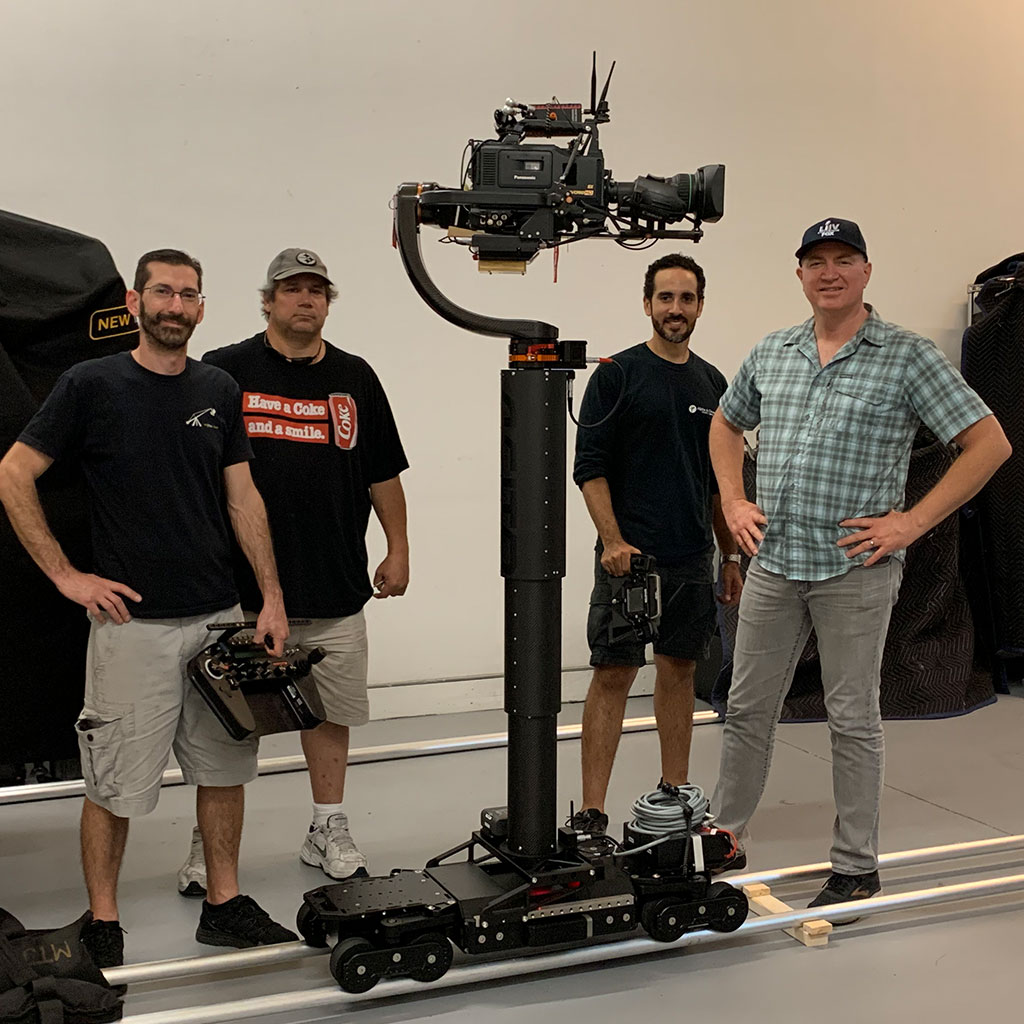
A robotic dolly is a camera support and motion system that allows you to move the camera in a controlled, repeatable way using motorized or programmable mechanisms, rather than relying solely on manual push/pull operations. This system typically comprises:
- A motorized base / drive unit (on wheels or track) that moves the camera rig.
- A controller — either a joystick, wireless remote or software interface — that lets the operator program speed, path, direction, start-stop, even repeat takes.
- A camera mount (head, gimbal, remote head) secured on the dolly platform.
- Optional track or free-roaming tires (for outdoors, multiple terrain) and motion-control integration for advanced shots.
For example, the system offered by MTJIBS for rental is the AGITO Dolly (by Motion Impossible) as a fully modular robotic system capable of wireless operation, multi-terrain and track use.
How it works:
- The operator sets the route, speed, and any repeat-take parameters.
- The system drives the camera along the path, at the set speed.
- If multiple takes are needed (for VFX, compositing, split screens), the exact same camera motion can be repeated automatically, ensuring perfect alignment.
- Some systems allow remote head control (pan/tilt/zoom/focus) in sync with the dolly movement.
- Many modern robotic dollies can switch between “track mode” (on rails) and “free roam mode” (on tires) for versatile location shooting. The AGITO can be built in Trax Mode or Sports Mode.
In short: you get programmable camera motion, higher consistency, and integration with sophisticated camera systems — all of which reduce the margin for error and increase creative possibilities.
Robotic Dolly vs Traditional Dolly: Key Differences
It’s important to understand how a robotic dolly stacks up against a traditional dolly (rail or wheeled) in practical terms. Here are the key differences:
In practice: if you need one-take repeatability, complex paths, remote operation or live multi-camera integration, a robotic dolly clearly has the edge. For simpler shot designs with minimal complications, a traditional dolly may suffice.
When to Use a Robotic Dolly in Production
Knowing when to deploy a robotic dolly is key. Here are scenarios where it makes sense:
- VFX & compositing work: When you need multiple takes, exact camera paths, maybe plate shots and live action combined. Repeatability matters.
- Live events, sports broadcasts or large-scale productions: Where you need smooth tracking across terrain, high speed, minimal operator interference (e.g., sports mode of AGITO
- Commercials or product videos with dynamic motion: When you want crisp, repeatable moves around objects or people, especially for product reveals or cinematic sequences.
- Virtual production or LED volume sets: Robotic dollies integrate well with motion-control systems, Unreal Engine workflows and need for precision.
- Complex environments or terrain: For example, when track can’t be easily laid or you’re shooting outdoors and need responsive motion over grass/gravel/terrain (AGITO’s Sports Mode)
- Time or safety constrained sets: Wireless operation and remote control reduce operator footprint, allowing safer distancing (relevant in recent years)
On the flip side: if your shoot is simple, limited to one camera, on flats, and the budget is tight, a robotic dolly may be overkill.

Benefits of Renting a Robotic Dolly with Crew
Renting a robotic dolly with a trained crew offers major advantages:
- Technical Expertise & Setup: A rental house like MTJIBS provides not just the system (e.g., AGITO) but the crew to set it up, calibrate, test the path, integrate head control, and ensure safe operation.
- Time Efficiency: Setup, calibration and testing of motion takes time; experienced operators accelerate this.
- Repeat-take capability: For product, VFX or live broadcast shoots, the ability to repeat an exact move without manual variation is golden.
- Safety & reliability: These systems involve motorised rigs, remote controllers, terrain changes and high speed. Professional crew reduce risk.
- Creative collaboration: The camera movement becomes another creative tool; the operator can advise on path planning, motion timing, transitions and dynamic moves.
- Gear matching & accessories: MTJIBS lists optional add-ons (e.g., AGITO Tower, MagTrax magnetic strip, curved track) to accommodate tricky environments.
By renting both the robotic dolly and the experienced crew, you gain a production-ready motion control solution without purchasing the gear outright — ideal for commercial shoots, one-off events or location work.
Popular Robotic Dolly Models (Agito, etc.)
Here are some strong contenders in the robotic dolly market:
- Scarab 400 Robotic Camera Dolly – A high-end robotic camera dolly with significant payload and control, representative of what top rental houses carry.
- Cinetics CineMoco Dolly – More compact, portable motion-control dolly; useful for smaller rigs or tabletop work.
- Motorized Camera Dolly Scarab – Another premium solution showing how high the investment goes.
- For reference, MTJIBS features the AGITO system which supports modular track/free-roam usage, wireless operation, high speed and large payloads.
When you rent from MTJIBS, you’re getting the AGITO platform (or similar) with the support of their team in South Florida. This gives you access to high-end robotic dolly capability without buying.
What to Look for in a Robotic Dolly Rental
Before you book your rental, make sure you ask and check for:
- Payload Capacity – Does the dolly support your camera, lenses, accessories and remote head? For example: AGITO Sports mode supports ~70 lbs payload; Trax mode up to ~141 lbs.
- Movement Options – Can it operate on track (Trax) and free-roam (Sports mode)? Do you need curved track, straight track or magnetic strip (MagTrax)?
- Control System & Repeatability – Will you get software/remote control to program moves and repeat takes?
- Accessories & Add-ons – Tower for vertical movement, risers, custom track, magnetic strip path. MTJIBS lists all of these.
- Crew & Support – Does the rental include an experienced operator/technician? How many hours of setup/testing?
- Location & Terrain Suitability – If you’re shooting outdoors, on different surfaces, or in tight spaces, confirm the system can handle it.
- Power & Transport Logistics – How many cases, how much space, what power/battery requirements, how much time for setup/breakdown?
- Cost & Booking Terms – Are there minimum days, travel fees, overtime, insurance?
- Repeatability & Data Integration – Especially for VFX or LED volume work, ask about data outputs, integration with Unreal Engine, camera motion data.
- Safety Features – Emergency stops (E-Stop), sensor bumpers, remote cut-offs. Example: AGITO includes E-Stop and Mag-Stop sensors.
By vetting these criteria, you’ll ensure the robotic dolly you rent fits your production needs and doesn’t become a logistic burden.
Estimated Costs & Setup Considerations
Robotic dolly rentals range depending on system, accessories, crew and usage. Here’s a rough breakdown (based on industry norms plus context from MTJIBS):
- Basic robotic dolly unit (no crew): $800 – $1,500 per day
- Robotic dolly with operator/technician: $1,500 – $3,000 per day
- Advanced motion control system with full package (track, free-roam, tower, remote head, motion data) : $3,000 – $5,000+ per day
Setup considerations:
- Allow 30 minutes to 2 hours (or more) for calibration, testing, route programming, safety checks.
- Transport of rig and track may require truck/van, additional crew.
- If using track (curved/straight) or magnetic strip (MagTrax) you must account for floor time, audience/venue logistics.
- Outdoor locations may require stabilising terrain, insurance, weather contingency.
- For live events or multi-camera rigs: coordination with broadcast crew, time-codes, sync with remote head, possibly motion data output.
Our team at MTJIBS wants to note that the AGITO system’s flexibility “on track or off” and supported curved track, MagTrax and free-roam tires, means additional setup time for custom paths.
FAQs About Robotic Dollies
A robotic dolly emphasises controlled camera movement — motorised drive, repeatable path, remote operation. A full motion control system may add extra axes (tilt, pan, zoom, focus), automated head movement, and integration with animation or VFX workflows. Some robotic dollies incorporate motion-control elements (e.g., camera head automation), but primarily robotic dollies handle the camera platform movement.
Yes — many modern systems are built for multi-terrain operation. For instance, the AGITO Sports Mode is designed to run on asphalt, dirt, grass or even gravel surfaces. Always confirm terrain suitability, safety and battery/power logistics with the rental house.
Typically anything from 30 minutes to 2 hours (or more) depending on terrain, track/curved path, calibration, wireless setup, camera head integration, and rehearsal. Allow for extra time if using custom track or complex paths.
While basic units may be operated with minimal training, commercial productions should engage trained operators. The setup, safety, repeatability and remote control aspects require expertise — many rental houses include the operator as part of the package (e.g., MTJIBS).
Absolutely. Because robotic dollies offer exact camera motion repeatability and programmable paths, they’re well suited for VFX, compositing and virtual production. Data from the controller can often be exported to motion tracking/vfx software. When paired with an LED volume or Unreal Engine environment, the precision of a robotic dolly offers major advantages.
Final Thoughts: Is a Robotic Dolly Right for Your Shoot?
In conclusion: a robotic dolly is a potent addition to a production toolkit — but it’s not a one-size-fits-all solution.
If your shoot demands precision (repeatable moves), creative flexibility (dynamic paths, terrain change), remote or wireless operation, or integration into VFX/virtual production, then a robotic dolly is absolutely worth considering. And when you rent from MTJIBS, you get the gear and the experienced crew to unlock its full potential.
On the other hand, if you’re filming simpler sequences with limited movement, without the need for perfect repeatability or terrain mobility, a traditional dolly might suffice and save cost and logistic overhead.
Bottom line: Evaluate your shot list, terrain, budget and crew workflow. If the benefits of a robotic dolly align with your production goals, then move forward. For many high-end commercials, branded content, live broadcast and VFX shoots, the answer will be “yes.”
Ready to take your camera movement to the next level? Request a quote for the AGITO robotic dolly system (and their full suite of camera support gear). With MTJIBS, you’ll gain access to a fully modular robotic dolly (track + free-roam + tower options) and expert operators who understand high-end production workflows. Elevate your next shoot with precision motion control. Contact MTJIBS today!

MTJIBS
Contact us today for a quote on the best professional camera movement & crew rental for your next video production project.
![[Top #1] Film Equipment Rental | Get a Quote Today | MTJIBS | Technocrane 22 Telescoping Camera Crane | Camera Movement Equipment Rentals | Corporate AV Productions](https://mtjibs.com/wp-content/uploads/2022/09/MTJIBS-Featured-Image-1280x720-equpment-page.jpg)